
Scheduler Overview
TouchPoint’s Scheduler lets you organize people into Teams and Time Slots so you can easily see who has committed to serve, bring something, or attend at a given date and time. The examples below show a few ways to use it.
Use Case - Volunteer Scheduler
To staff a worship band for Sunday morning services, create Teams such as Vocals, Guitar, and Keyboards on each Sunday Time Slot. Musicians sign up for (or are assigned to) the Team they will serve on, and the Scheduler shows which positions are still open.
Use Case - Food Sign-Up
To organize a Sunday School class potluck, create Teams for the food items needed, such as Main Dish, Side Items, and Drinks. Class members choose the Team for the item they will bring, and the Scheduler shows how many of each item are covered.
Use Case - Nursery Drop-Off Reservations
To spread out nursery drop-offs on a busy morning, create a Time Slot for each drop-off window. Parents reserve the window in which they will drop off their children. A single Team per Time Slot is usually enough.
Use Case - Baptism Schedules
To schedule baptisms, create a Time Slot for each available date and time. Candidates sign up for the Time Slot that works for them. Sub-Groups are usually not needed.
Roles
Users with the Admin role, or with both the Edit and Access roles, can create Scheduler Involvements, configure their settings, and add, move, and remove people on the Scheduler.
Leaders with the OrgLeadersOnly role can view the Scheduler for an Involvement they lead and can email a Time Slot or Team and open its Meeting page or Rollsheet. They cannot edit the Scheduler.
Administrative Settings
A user with the Admin role can find the Scheduler-related settings at Admin > Advanced > Settings, on the Features tab, under Volunteer Scheduler.
- Show Commitment Indicators
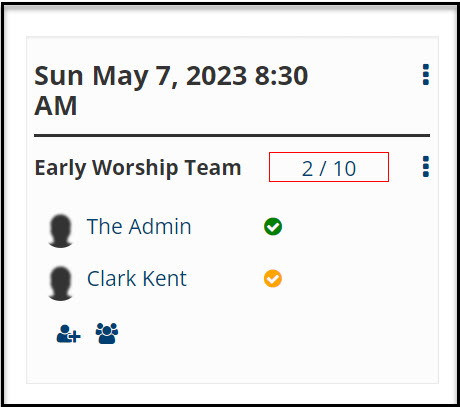
Set this to True to show a check mark icon next to each person on the Scheduler tab. A green check mark means the person has Committed (or is serving as a substitute); an orange check mark means the person has been Scheduled but has not committed yet. The default is False.
- Committed Reminder Text and Uncommitted Reminder Text
These settings hold default text-message wording for future Scheduler text reminders. Text reminders are not currently available, so changing these settings has no effect.
Scheduler Setup
- Step 1
Navigate to Involvements > Add Involvement.
Note
A Scheduler must be a newly created Involvement. You cannot change an existing Involvement’s Registration Type to Scheduler, and the Copy Settings option is not available for Scheduler Involvements.
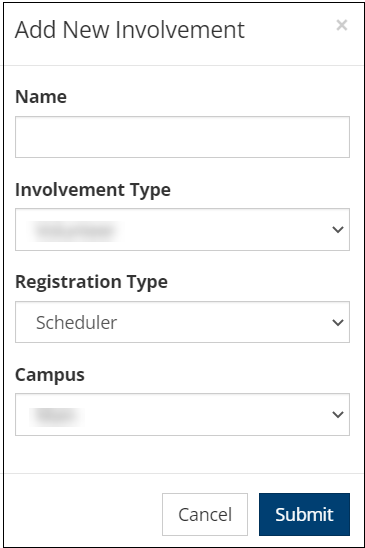
- Name
Enter the name of your Involvement.
- Involvement Type
Choose the Involvement Type.
See also
- Registration Type
Choose Scheduler.
Warning
Once an Involvement is created with the Scheduler Registration Type, you cannot change it to another Registration Type.
- Campus
Choose the Campus associated with your Scheduler.
- Step 2
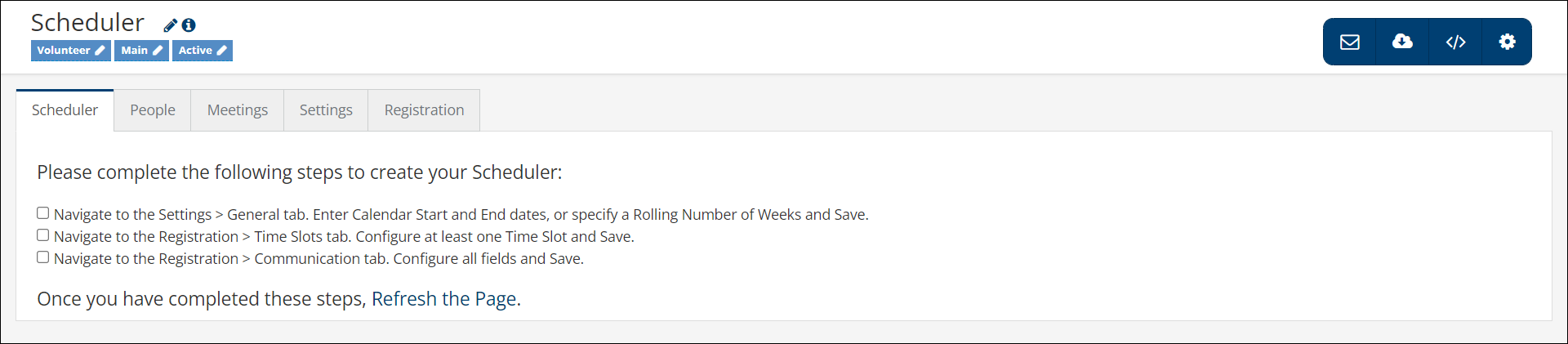
After you create the Involvement, the Scheduler tab lists the minimum setup steps required before your Scheduler appears:
On the Settings > General tab, enter Calendar Start and Calendar End dates, or a Rolling Number of Weeks, and save.
On the Registration > Time Slots tab, configure at least one Time Slot and save.
On the Registration > Communication tab, configure all fields (including at least one Email From person) and save.
Each box is checked as you complete its step. When all steps are done, return to the Scheduler tab and click Refresh the Page to see your Scheduler. See the following articles for details about all settings.
Note
If you check Only use ad hoc on the Registration > Time Slots tab, you can skip the Calendar Start/End or Rolling Number of Weeks step and the Time Slot step. Use this option if your Scheduler does not repeat (for example, an event that takes place on a single day or weekend).
Scheduler - Part 2
Latest Update |
10/21/2026 |
Added role requirements, updated menu paths and setup steps, clarified the commitment indicators, and noted that text reminder settings are not yet in use.