
First Steps with your TouchPoint Database
- First Steps
Below are the first steps for you to take before you begin using your TouchPoint database. Most of the steps are for the person who will be your System Administrator (a user with the Admin role), but the information will be helpful for other users as well.
See also
When we create your database, we create a people record for the person designated as the System Administrator for your TouchPoint database. We assign that person a user account, and they receive an email with their credentials.
- Support
You can have up to 4 Support Admins on your database. These users have unlimited email support with TouchPoint. When we set up your database, our team also sets up the user(s) you decide should be your Support Admin(s); Support Admins have the Support role. For the fastest support, click the ? (Help) icon in the top right corner of any page, and then search by topic or keyword. If you do not find the answer and you are not a Support Admin, contact one of the Support Admins at your church. Their names are listed on the Contact Support tab of the Help page. See Help Documentation below for more about finding answers to your questions.
- Support Admins - Contact Support
If you are a Support Admin and need help answering a question, click the ? (Help) icon, select the Contact Support tab, enter a Subject, choose a Priority, type your question, and click Submit Request. This gives us your name, your church name, and your database URL, which is why it is the best way to request support. You can enter the email address of the staff member who needs help in the CC field so that person also sees our reply. Requests are received by the entire support team to ensure a quick response.
When we create your database, there are 3 records in it that need to remain there in order for you to receive support from TouchPoint:
The Admin
Checkin Ministry
App Tester
These are there to allow us access to your database when you need help.
See also
If, for some reason, you cannot access your database, you may email support@TouchPointSoftware.com. Otherwise, for the fastest support, use Contact Support on the Help page in your database.
- Help Documentation
You can go directly to the Help Documentation from your TouchPoint database by clicking the ? (Help) icon in the top right corner of any page. On the Search Documentation tab, enter a topic or keyword and click Search, or click the Documentation Website button to go to the home page of the documentation. Once there, you can select one of the main headings to view articles related to that heading, or search by topic/keyword from anywhere in the documentation. The Training tab has a Training Website button that opens the TouchPoint Training website, where you can find training resources. We encourage you to look in the documentation first before having your Support Admin contact us. You can often find just what you need faster that way. The article listed below contains more about finding the answers to your questions.
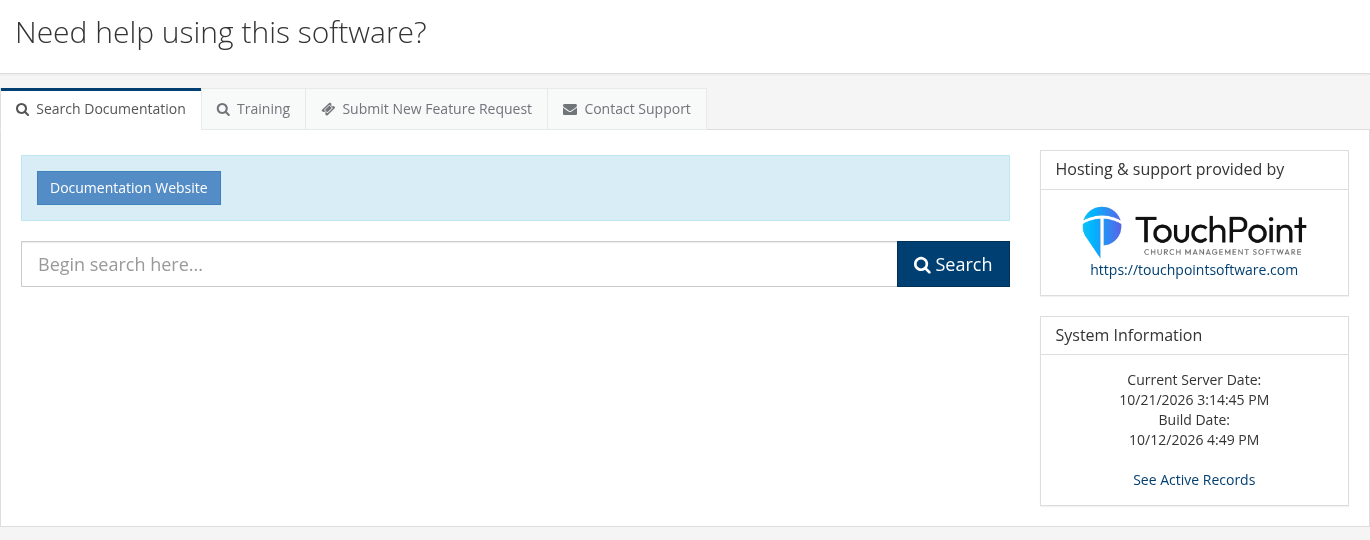
Help page
See also
- TouchPoint News
We communicate with our users through the TouchPoint News Blog and periodic newsletters. Encourage all of your church’s users to read the blog so they stay up to date on new features and updates. These posts also display on your TouchPoint Home Page.
See also
- TouchPoint Status Page
The TouchPoint Status Page shows announcements regarding system issues and uptime history. This is a good website to bookmark and the first place you should look if you are unable to access TouchPoint or are experiencing an unusual problem.
Now you are ready to get started:
Settings
There are some Settings you need to set or change. All of these are found under Admin > Advanced > Settings, which requires the Admin role. Each setting below is on the System tab; you can also type the setting name in the Search settings by name… box at the top of the page to find it quickly.
To change a setting, click the value beside the setting name (it says Empty if nothing has been entered), enter or select the new value, and click the blue check mark button to save the change.
- NewPeopleManager (System > Administration)
Click the value beside NewPeopleManager.
Search for and select the person(s) who should serve in that role. You may select more than one person; the first person listed owns the New Person Data Entry tasks. Only users with the Admin, Finance, FinanceAdmin, or Membership role appear as options.
Click the blue check mark button to save the change.
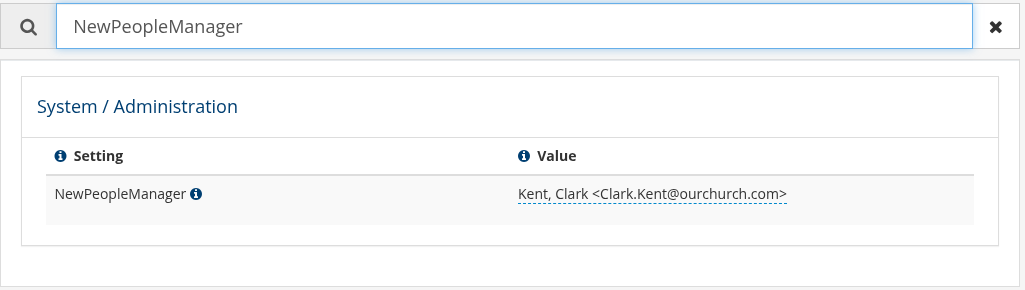
NewPeopleManager setting
See also
- Church Address (System > Church Info)
Click the value beside Church Address.
Enter your church address - example:
2000 Appling Rd, Cordova, TN 38016.Click the blue check mark button to save the change.
See also
People Page to learn how this address is used for driving directions.
- Admin Mail (System > Administration)
Click the value beside Admin Mail and enter the email address for your System Admin if it still shows a TouchPoint email address.
Click the blue check mark button to save the change.
This is the person who receives admin notifications and from whom standard automated notifications are sent. You may want to create a generic people record (e.g. Church Office) with a generic email address (e.g. office@ourchurch.org). Just be sure someone monitors that email account, as people will sometimes reply to these notifications.
See also
Other Tasks and Resources
- Create People Records
Create people records for your staff or volunteers (if records were not imported). To add people from People > Add Person while you populate a new database, a user with the Admin role must first set the MenuAddPeople setting to True.
See also
- Create User Accounts
Create user accounts and assign roles for staff and volunteers. This requires the Admin role.
See also
- Create Metro Zip List
Create the list of Zip Codes for your local area at Admin > Advanced > Zip Codes, assigning the proper Resident Code. This requires the Admin role.
See also
- Populate Your TouchPoint Database
Add your congregation to the database if we did not import records from a previous database (a data conversion).
There are a couple of ways to do this:
You can use the Insert People spreadsheet to help streamline the process.
Or you can add new records directly to your new database.
Also, be sure to review the section above regarding the NewPeopleManager setting.
- Involvements and Attendance (Meetings)
Create an Involvement for your Worship Service (if one was not imported during a data conversion). By default, adding an Involvement requires the Edit role.
See also
Begin creating meetings for your Worship Service, enter a headcount each week, and add any new guests to the meetings.
If your church is interested in secure child Check-In, you will want to read the help articles about TouchPoint Check-In. You will find articles about how to set up your Involvements, where to find equipment, and more.
See also
Tip
Our Check-In software is not exclusively for use with children. You can use it for any age.
Other Administrative Tasks
- Contributions
Create the list of Contribution Funds at Finance > Setup > Funds, which requires the Admin or Finance role. If your data was imported from a conversion, your funds were imported as well, so just verify those that need to remain open.
See also
Set up your Contribution Statement Header and Notice. These display on the Contribution Statement.
Verify that the Contribution Statement Types and Envelope Options are set correctly for your donors.
There are a number of help articles relating to Contributions, Funds, Envelopes, Statements, and Pledges that you will want to read.
See also
- Miscellaneous Items
Member Status
By default, newly added records have a Member Status of Just Added (unless the Member Status was already mapped during a data conversion).
You can change the Member Status for a group of records at Admin > Tools > Update > People. This allows you to quickly change everyone’s church member status from Just Added to Member, Previous Member, or Not Member.
Batch Updates
Admin > Tools > Update > People allows you to update a number of fields on people records as a batch process. This requires the Admin role. Use it very carefully, but it can be a real time-saver.
Admin > Involvements > Update Involvements allows batch updates for Involvements as well. Only a user with the Admin role can perform the batch update.
See also
Latest Update |
10/21/2026 |
Updated the Settings, Zip Codes, and batch update navigation paths; corrected which users the NewPeopleManager setting lists; updated the Help page and Contact Support steps; added role requirements and current screenshots; and corrected the TouchPoint News Blog link.